Everyone has something that they cannot get enough of. In my case, I love mechanical things, and I cannot help watching gears and linkages. To me, there was one thing I wanted for a long time. It was an eraser crumb cleaner. I saw it somewhere in Japan long ago. Since then, I wanted it. This product is undoubtedly my favourite among the items I bought in Japan this time. Here it is.
Going to Japan this time was the best opportunity to get it. However, even when I was in Japan, I could not find it in shops, so I searched it on the internet. I found a lot on the internet even though I could not find any at retail shops.
It is a tiny toy-like tool made with plastic. It costs about six dollars. As it is even that small, it is well-made, and I am impressed.
On one side of the car, there are two tiny gears. As the rear tyres rotate, the smallest gear rotates and transmits power to the larger gear. The larger gear is connected to a zigzag bar. Two tiny brooms are linked to the bar, moving back and forth as the bar rotates. The movement is smooth, and it looks fun to watch.
I am not sure who invented it. At least, I guess that I saw it more than 15 or 20 years ago. It may not be very practical, but I love the idea of it. I can only make something with timber, so making tiny things like this car is not easy. I wonder if I could someday make a small mechanical toy like this car.
There
was one accessory I had always wanted, and I finally bought it. It was
designed and made by Yohei Nagatomi. Here is the accessory.
Unbelievably, those tiny gears rotate perfectly and smoothly. I love the
linkage mechanism, so when I saw it for the first time, I thought this
was perfect for me.
Yohei creates accessories with gears based on the idea of a "wearable link mechanism."
He started the creation for the purpose of making watches. From the
knowledge acquired in the process, he started making accessories. For
instance, this is one of the watches he made.
Let me show you more of his unique creations.
Here is Kinetic Heart. Rotating a gear in the lower heart-shaped frame,
the piston moves up and down, and the Geneva mechanism makes an
intermittent motion.
One of the great things about his creative work is that he integrates
various mechanisms into his work. When planetary gears are also made as
his creation, it looks like this.
Until I started writing about his creation, I didn't notice he had also
made a flower-shaped automaton.
It's interesting to see the different
mechanisms of the automaton because I have made the flower-shaped
automaton, "Columbine" before. As a matter of course the petal movements are similar,
but the mechanism is different.
As he says he is interested in watches, he has got tools I have never seen.
Look, this is a Boley's watch lathe. It's small!
This is a projector to scrutinize the shape of gears. I can imagine how much effort is required to make those small things.
His pendant head accessories are made with brass and duralumin.
Duralumin is commonly used for aerospace parts; it is a very light and
durable material.
He makes those accessories by build-to-order manufacturing, so it
requires about one week to be shipped. His shop can use PayPal, and it
was convenient for me.
Time flies like SpaceX, it is already mid-November. At least five
automata were supposed to be done in the plan this year, but I have made
only two and I have been racking my brains and thinking of a new
linkage system. On such an occasion, one interesting video that was
tweeted caught my eye. It was "Stone Circle Mystery" by Yosuke Ikeda.
It is not exactly an automaton, it is not a puzzle, and even more, it is
not magic, yet it has fun elements related to puzzles with a
mathematics' flavour. I thought puzzle lovers would love his creations.
Yosuke Ikeda is also famous as a performer. He has lots of performing
experiences overseas, including Austria, Germany, Switzerland, Taiwan,
and so on. This is one of his popular performances, "Hello Goodbye"
which made him well known.
Firstly, I assumed that he is a designer and a street performer, and I
was surprised to know that he is a mathematics teacher at a prep school
and the author of math books too. As the saying goes, God does not give
two gifts to one person, but it seems like there is an exception.
The creations that such a talented guy has come up with are amazing.
Probably, it is because I like gears, but this video,"Marble Machine "Penrose Stairs"" is fantastic.
Especially, I like the three cubes that rotate. I cannot understand why
it got only 126 clicks on the "Like" icon as of today.
The latest project he is carrying is AlgoLoop. It looks like a small
propeller or fan. He has put it on KICKSTARTER and is raising money
toward production. There is a page that is written about the details of
AlgoLoop on KICKSTARTER together with "Risks and challenges" written by
Yosuke.
Most visitors to this blog are puzzle lovers. So, in the end, I will
introduce his puzzle, "Square Puzzle." Yosuke says that this is a new
variation of the Missing square puzzle. Since it has been well received,
he is thinking of merchandising.
I have pasted several links of Yosuke below.
His website has explanations about his creations and performance in both
English and Japanese, so I do not think I need to write a lot here.
Please visit his website and his YouTube pages, you will find more fun there.
Yosuke Ikeda Are you looking for something different? THIS IS IT
One of my dreams is making automata, and gears are indispensable. I have
made several wooden gears using the scroll saw long ago, but no matter
how hard I try, it is almost impossible to make gears accurately.
That
is where the CNC router comes in. I thought it would be a good practice to make some gears using the CNC
router. I tend to aim at a rather high target that doesn't fit my
skills. I have never made gears using the CNC router, therefore, I told
myself "Just make simple gears, it is a training this time."
Then, I had considered several designs of automaton with some gears.
Common designs of automata are concrete shapes like; a dog, bird,
butterfly and doll. I have seen some YouTube videos and there are many
beautiful artistic automata.
Hmm, what shall I make?
I wanted to make something that nobody made, not
a doll or not an animal. Yes, I know. I should better make something
simple at first. Having said that, it wouldn't be fun only making gears.
I thought that I wanted to make something extra added.
I had considered some designs, but I felt something different. I wonder
how many days I have spent thinking up ideas. Anyway, I finally got a
convincing idea, that was the one using moire. Some gears have several
holes on the surface of a gear. Probably, it is not a design, it is to
make the weight of the gears light. If I make moire pattern holes
instead, how would it be?
Firstly, I was going to make the same pattern holes to two gears and
pile them up. I told my idea to my husband, Juno and he said, "Why don't
you make the same pattern on the surface of a board that holds gears?"
Wow, that's a good idea! That's easier than rotating two gears. Let's go
with it!
Once the outline was decided, I could work smoothly ... I expected, but I
was wrong. I didn't know about moire and I didn't know what kind of
pattern can be appear well in moire. What I did was make patterns
suitably on the 2D software and I made some animation. Some could appear
moire and some couldn't.
Hmm. I was stuck.
Here again, another bad habit came out. I didn't know what the result
would be, but let's try it! I was not decisive, I was just getting tired
of trying patterns of moire. I had exported the data of gears from the
software Gearify. At this time, I found a familiar face on the website
of the software, it was Oskar van Deventer. It was nice to know that he
also uses the same software.
I imported the data to 3D software and added several drawing lines on
it. Then, I exported the DXF data. The next step was importing the data
to the Cam software and setting several data like; the diameter of the
bit, depth of the holes and so on, then I exported a G-code. The last
step was importing the G-code into the CNC software. All procedure on
the computer was finally done. Oh, it took a long time.
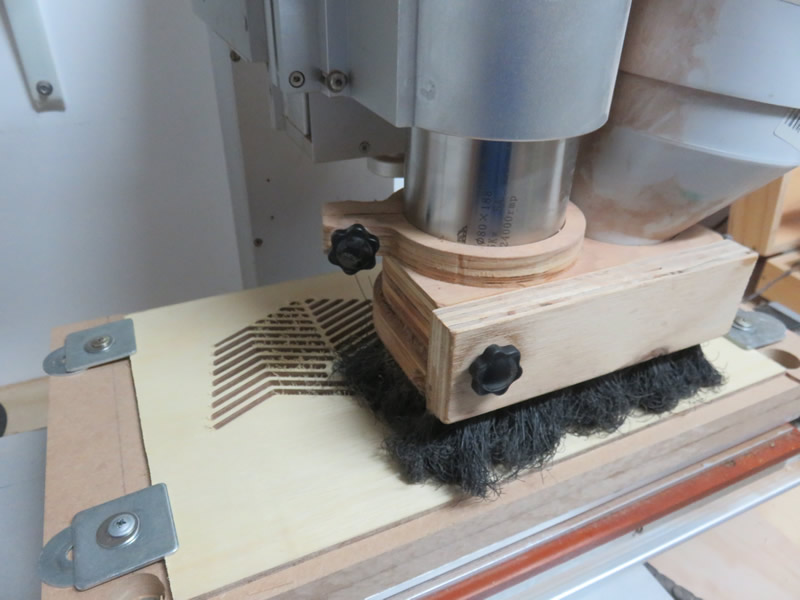
Here are pictures of cutting gears and the board using the CNC router.
I had experienced several issues while I was using the CNC router. I can
say that there are lots of pitfalls using a CNC router. If you lose
your attention, you may make a terrible mistake. CNC routers are very
useful machines, but it is not easy to use. I am very sure if Juno
hadn't kept an eye on my work, I would have made many mistakes or
probably, I might have broken off some bits.
Ta-dah! This is my first gear creation "Moire Gears No.1."
This is the second "Moire Gears."
I named it "Moire Gears." I have
made the second one too. The square pattern on the first one didn't
show moire, so I have changed the pattern. It works well.
Can you see
moire? I could experience how the CNC router works. Thank you for your
help, Juno. It was a wonderful experience for me. I am going to make
something different from "Moire Gears" next.