Time flies like SpaceX, it is already mid-November. At least five
automata were supposed to be done in the plan this year, but I have made
only two and I have been racking my brains and thinking of a new
linkage system. On such an occasion, one interesting video that was
tweeted caught my eye. It was "Stone Circle Mystery" by Yosuke Ikeda.
It is not exactly an automaton, it is not a puzzle, and even more, it is
not magic, yet it has fun elements related to puzzles with a
mathematics' flavour. I thought puzzle lovers would love his creations.
Yosuke Ikeda is also famous as a performer. He has lots of performing
experiences overseas, including Austria, Germany, Switzerland, Taiwan,
and so on. This is one of his popular performances, "Hello Goodbye"
which made him well known.
Firstly, I assumed that he is a designer and a street performer, and I
was surprised to know that he is a mathematics teacher at a prep school
and the author of math books too. As the saying goes, God does not give
two gifts to one person, but it seems like there is an exception.
The creations that such a talented guy has come up with are amazing.
Probably, it is because I like gears, but this video,"Marble Machine "Penrose Stairs"" is fantastic.
Especially, I like the three cubes that rotate. I cannot understand why
it got only 126 clicks on the "Like" icon as of today.
The latest project he is carrying is AlgoLoop. It looks like a small
propeller or fan. He has put it on KICKSTARTER and is raising money
toward production. There is a page that is written about the details of
AlgoLoop on KICKSTARTER together with "Risks and challenges" written by
Yosuke.
Most visitors to this blog are puzzle lovers. So, in the end, I will
introduce his puzzle, "Square Puzzle." Yosuke says that this is a new
variation of the Missing square puzzle. Since it has been well received,
he is thinking of merchandising.
I have pasted several links of Yosuke below.
His website has explanations about his creations and performance in both
English and Japanese, so I do not think I need to write a lot here.
Please visit his website and his YouTube pages, you will find more fun there.
Yosuke Ikeda Are you looking for something different? THIS IS IT
The
2020 Nobel Prize in Physics has been awarded to Roger Penrose. I
believe that most puzzle lovers like, for example, the Penrose triangle.
If you love what Roger Penrose has accomplished, I am very sure that
you may be interested in a guy who designed lots of mathematical things.
His name is Akio Hizume.
If you had attended the International Puzzle Party 30 (IPP Osaka +
Hakone 2010) you might have met Akio. He was one of the lecturers in
Osaka and held a workshop on "Pleiades."
Pleiades had been displayed in various places. Here is one of the huge
Pleiades hanging from the ceiling of a church in Switzerland.
Unfortunately, it is not there now.
Two pictures below were taken at Marunouchi Building which is in front
of the Imperial Palace, Tokyo. It looks like a Christmas tree. The star
is Pleiades and the Christmas tree part is Fibonacci Tower which is also
designed by Akio.
There is one interesting story. Akio put a bulb inside Pleiades and
threw it from the 6th floor of the building (Depending on the countries,
it would be the 5th floor due to there being no ground floor in Japan).
The ground he threw on was covered by concrete, yet Pleiades and even
the bulb did not break. Isn't it amazing?
According to Akio's guessing,
the Pleiades itself became like feathers and worked as a parachute,
falling at a constant speed, and cushioning the bulb to protect it.
He has designed so many things, so I present here Akio's other works. This
is Sunflower Tower, 8 m high (26.25 ft). It is constructed with 150 bamboo stalks woven
into a double spiral.
Akio occasionally gave lectures at Musashino Art University in Tokyo and these pictures show what he had made there.
He is an architect, therefore, of course, has designed some buildings. Those small models are tea houses that he designed.
Akio designed an architectural prototype based on the plant's
phyllotaxis spiral. This is my personal opinion, but some of his
architectural models seem to have a similar concept as Islamic
architectural design. What I mean is those designs have mathematical
beauty.
This time, my blog became longer because Akio has so many original
designs. I reckon his keen insight into form and mathematical sense will
lead him to create even more original designs in the future.
Like he attended the IPP30 as a lecturer, he has been attending many
events worldwide. If you have any questions or would like to ask him to
make something his originals, please contact him directly.
I have finally finished making my third automaton.
I have been busy
these days, but when the CNC router was not in use, I cut all the parts
of an automaton. While the CNC router was cutting the parts, I could
work for my regular work, making puzzles and it was very time efficient.
Same as before, I used plywood this time because this is a prototype.
Plywood will not warp, and it is good for making gears. On the other
hand, cheap plywood like I bought does not look very good. I bought
plywood at the same shop, and unfortunately, there were variations in
quality. Some top boards easily come off and it was a bit awkward.
At first, I drew pictures of the automaton using 3D software. It can be a
help to understand each position and also it can export the data for
the CNC router. I do not know how other automata creators do, but to me,
this method is convenient. After exporting the data, there were several
settings and work and then, it was the time for cutting. This is one of
the exciting moments.
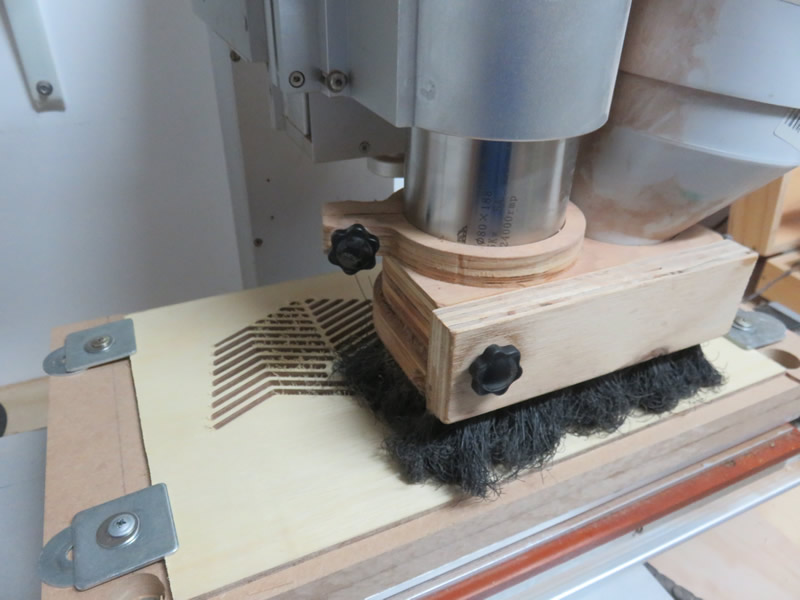
This is the picture of cutting parts with the CNC router.
I needed some
tiny parts and I prepared more than I needed, because tiny parts might
be inhaled by a dust extractor after cutting. This is the tiniest part
that survived.
After cutting all the parts, I assembled them together. The picture below is gluing the jockey and holding it with a clamp.
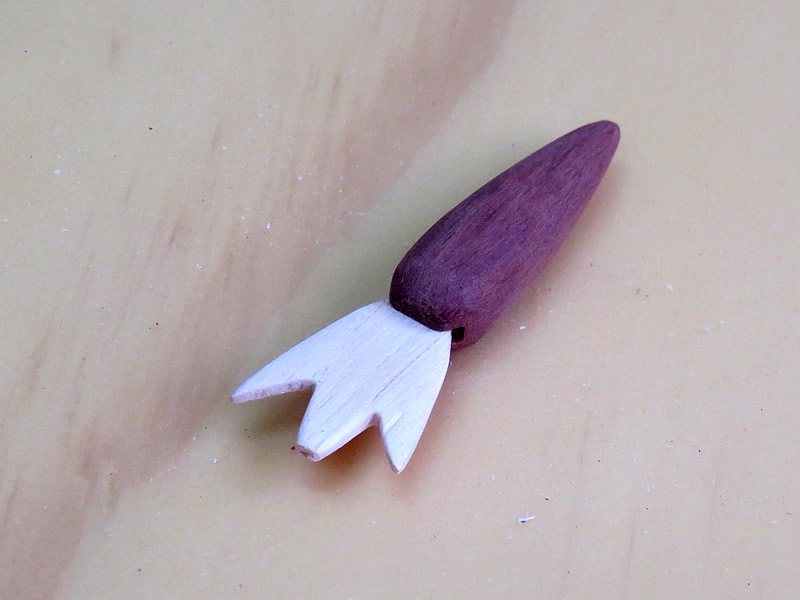
I said that I used plywood, but there were two exceptions, one is the
base and another one is a carrot. This prototype does not have any
colour and looks bland, I wanted different colours. This carrot was made
from Jarrah.
This automaton is based on my old online jigsaw puzzle design. A jockey
and a horse are riding on a bicycle and the jockey is holding a fishing
rod that has a carrot on the end, and the horse is pedaling the bicycle
instead of running. The horse's eyes are, of course, chasing the carrot.
After I made this automaton, I thought that I could also make another
version of this. The horse that sits on the bicycle can be replaced with
a rabbit. Replace the carrot with a wad of bills and the horse can be
changed to a human.
I am mostly satisfied with the result of the automaton. I made the
jockey's leg so that it can be wagged, but the automaton does not
vibrate as I thought, and it does not wag at all. It was a
miscalculation.
Unexpectedly, there is one that is satisfied with the automaton more
than I am, it is my cat. He loves punching the carrot very much. He is
not interested in some toys I bought for him, but he loves the carrot.
It was another of my miscalculations. I put the automaton out of reach
of the cat for safety.
I have been watching the YouTube video, Maker's Muse, which introduces
models that are made with a 3D printer. This channel administrates by an
industrial designer, Angus Deveson.
My favorite videos of his I used to watch are usually related to gears
like Geneva mechanism, but the latest video that is not related to gears
caught my eye. It was about a puzzle made for a Sulphur-crested
Cockatoo named Popeye.
As he introduces the Sulphur-crested Cockatoo on the video, they have a
destructive reputation and are intelligent. I have incurred numerous
damage by them pulling and biting the plants I had grown, yet I do not
hate them, or more than that, my curiosity for those tinker birds has
increased.
There is another example that proves their intelligence. The
Sulphur-crested Cockatoo that lives in Sydney seems they figured out how
to open the garbage bin lid. They open the lid using their foot and
beak.
Here is the link of the news article.
ABC News
Sulphur-crested cockatoos raiding wheelie bins are (annoying) examples of animal behavioural adaptation
Having a skillful beak, feet and strong curiosity, I would not be
surprised if they solve puzzles, and here it is, a puzzle for the
Sulphur-crested Cockatoo.
Seeing is believing, please watch the video,
"Can Wild Parrots Solve Puzzles?"
Even I knew they are intelligent birds I did not expect Popeye can solve
the puzzle in such a short time. It seems like Popeye remembered
pulling the dowel out. The second time the attempt took only under 30
seconds.
On the video, Angus says that he welcomes the new puzzle ideas for
Popeye. I know there are puzzle lovers visiting this blog. You guys
usually design puzzles for human beings, but why don't you try to think
of a puzzle for parrots?
One of my dreams is making automata, and gears are indispensable. I have
made several wooden gears using the scroll saw long ago, but no matter
how hard I try, it is almost impossible to make gears accurately.
That
is where the CNC router comes in. I thought it would be a good practice to make some gears using the CNC
router. I tend to aim at a rather high target that doesn't fit my
skills. I have never made gears using the CNC router, therefore, I told
myself "Just make simple gears, it is a training this time."
Then, I had considered several designs of automaton with some gears.
Common designs of automata are concrete shapes like; a dog, bird,
butterfly and doll. I have seen some YouTube videos and there are many
beautiful artistic automata.
Hmm, what shall I make?
I wanted to make something that nobody made, not
a doll or not an animal. Yes, I know. I should better make something
simple at first. Having said that, it wouldn't be fun only making gears.
I thought that I wanted to make something extra added.
I had considered some designs, but I felt something different. I wonder
how many days I have spent thinking up ideas. Anyway, I finally got a
convincing idea, that was the one using moire. Some gears have several
holes on the surface of a gear. Probably, it is not a design, it is to
make the weight of the gears light. If I make moire pattern holes
instead, how would it be?
Firstly, I was going to make the same pattern holes to two gears and
pile them up. I told my idea to my husband, Juno and he said, "Why don't
you make the same pattern on the surface of a board that holds gears?"
Wow, that's a good idea! That's easier than rotating two gears. Let's go
with it!
Once the outline was decided, I could work smoothly ... I expected, but I
was wrong. I didn't know about moire and I didn't know what kind of
pattern can be appear well in moire. What I did was make patterns
suitably on the 2D software and I made some animation. Some could appear
moire and some couldn't.
Hmm. I was stuck.
Here again, another bad habit came out. I didn't know what the result
would be, but let's try it! I was not decisive, I was just getting tired
of trying patterns of moire. I had exported the data of gears from the
software Gearify. At this time, I found a familiar face on the website
of the software, it was Oskar van Deventer. It was nice to know that he
also uses the same software.
I imported the data to 3D software and added several drawing lines on
it. Then, I exported the DXF data. The next step was importing the data
to the Cam software and setting several data like; the diameter of the
bit, depth of the holes and so on, then I exported a G-code. The last
step was importing the G-code into the CNC software. All procedure on
the computer was finally done. Oh, it took a long time.
Here are pictures of cutting gears and the board using the CNC router.
I had experienced several issues while I was using the CNC router. I can
say that there are lots of pitfalls using a CNC router. If you lose
your attention, you may make a terrible mistake. CNC routers are very
useful machines, but it is not easy to use. I am very sure if Juno
hadn't kept an eye on my work, I would have made many mistakes or
probably, I might have broken off some bits.
Ta-dah! This is my first gear creation "Moire Gears No.1."
This is the second "Moire Gears."
I named it "Moire Gears." I have
made the second one too. The square pattern on the first one didn't
show moire, so I have changed the pattern. It works well.
Can you see
moire? I could experience how the CNC router works. Thank you for your
help, Juno. It was a wonderful experience for me. I am going to make
something different from "Moire Gears" next.